
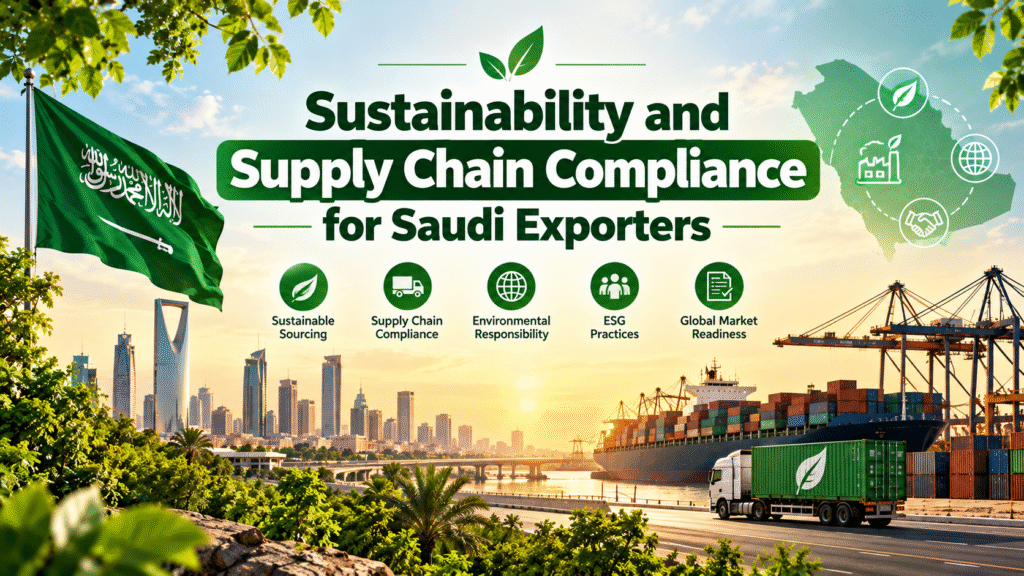
Saudi Arabia is becoming an increasingly important player in international trade, manufacturing, energy, petrochemicals, construction materials, and industrial exports. As businesses expand into global markets, sustainability and supply chain compliance have become essential considerations for exporters looking to build long-term international business relationships.
Today, international buyers are paying greater attention to how products are manufactured, where raw materials originate, how suppliers operate, and what environmental impact is associated with production. Exporters must increasingly demonstrate responsible sourcing practices, environmental responsibility, supply chain transparency, and compliance with international regulations.
For Saudi Arabian exporters, understanding these requirements is important for maintaining access to international markets, meeting customer expectations, and strengthening business competitiveness.
Detroit Consultancy provides sustainability consulting and supply chain compliance support to help businesses understand regulatory requirements, identify potential risks, improve supplier management practices, and develop effective sustainability strategies.
What Is Sustainability and Supply Chain Compliance?
Sustainability and supply chain compliance refer to the processes businesses follow to ensure that their sourcing, manufacturing, transportation, and distribution activities meet applicable environmental, social, ethical, and regulatory requirements.
It involves monitoring the complete supply chain, from raw material sourcing to the delivery of finished products.
For Saudi exporters, this means ensuring that suppliers follow appropriate environmental and labour practices, products meet destination-market regulations, and relevant business documentation is properly maintained.
Some important areas of sustainability and supply chain compliance include:
- Environmental management and pollution prevention.
- Responsible sourcing of raw materials.
- Supplier assessment and monitoring.
- Labour rights and workplace safety.
- Carbon emissions and energy management.
- Product quality and regulatory requirements.
- Supply chain transparency and traceability.
- Environmental, Social, and Governance (ESG) practices.
By implementing these practices, exporters can improve operational efficiency, manage risks, and build stronger relationships with international customers.
Why Is Sustainability Important for Saudi Exporters?
Sustainability is becoming an important factor in international business decisions. Global buyers, manufacturers, distributors, and regulatory authorities increasingly expect companies to demonstrate responsible business practices.
Saudi exporters supplying products to Europe, the United Kingdom, the United States, and other international markets may encounter different sustainability requirements depending on their products, customers, and destination countries.
Here are some important reasons why sustainability matters for Saudi exporters.
1. Access to International Markets
International markets increasingly require businesses to meet environmental, social, and product-related standards.
Exporters that understand these requirements can prepare their operations and documentation to meet applicable market expectations.
For example, businesses exporting certain products to European markets may need to consider regulations relating to deforestation, carbon emissions, chemicals, and product sustainability.
2. Building Trust with International Buyers
International buyers often evaluate suppliers based on product quality, pricing, reliability, and sustainability performance.
Companies that maintain transparent sourcing practices and demonstrate responsible operations can strengthen their credibility and improve their business relationships.
3. Reducing Supply Chain Risks
A supply chain may involve multiple suppliers, manufacturers, distributors, and transportation providers.
Without proper monitoring, businesses may face risks related to environmental violations, poor labour practices, inaccurate documentation, and sourcing irregularities.
A structured compliance system helps identify these risks and establish appropriate corrective measures.
4. Supporting Saudi Vision 2030
Saudi Vision 2030 places significant emphasis on economic diversification, environmental sustainability, industrial development, and responsible resource management.
Businesses can support these objectives by adopting more sustainable production methods, improving resource efficiency, reducing environmental impacts, and strengthening responsible sourcing practices.
5. Improving Business Competitiveness
Sustainability practices can help companies improve operational efficiency, reduce waste, manage resources effectively, and respond to changing international customer expectations.
These improvements can strengthen their position in competitive global markets.
Key Sustainability and Supply Chain Compliance Requirements for Saudi Exporters
Saudi exporters should understand the different compliance requirements that may apply to their industries and international markets.
There is no single sustainability certification or regulation that applies to every exporter. Requirements depend on the product, country of destination, business activities, and the company’s role in the supply chain.
The following areas are particularly important.
1. Environmental Compliance
Environmental compliance involves ensuring that business operations follow applicable environmental laws and regulations.
Saudi manufacturers and exporters should assess their activities in areas such as waste management, emissions, water consumption, energy use, and pollution prevention.
Depending on the nature of the business, relevant environmental requirements may involve:
- Environmental permits and approvals.
- Industrial waste management procedures.
- Air emissions monitoring.
- Wastewater treatment and discharge management.
- Hazardous material handling.
- Environmental impact assessments.
- Pollution prevention measures.
Businesses should maintain appropriate environmental records and regularly review their operational practices.
2. Responsible Sourcing and Supplier Management
Responsible sourcing is an important part of sustainable supply chain management.
Exporters must understand where their raw materials originate and whether their suppliers follow applicable legal, environmental, and social requirements.
Supplier assessment can include reviewing:
- Supplier business registration and legal documentation.
- Raw material origin information.
- Environmental management practices.
- Labour policies and workplace safety.
- Product quality certifications.
- Ethical sourcing procedures.
- Relevant sustainability declarations.
A structured supplier management system helps businesses identify potential risks and improve supply chain accountability.
3. Supply Chain Traceability
Supply chain traceability allows businesses to track products and raw materials throughout different stages of production and distribution.
For Saudi exporters, traceability is particularly important when supplying products to international buyers that require information about raw material origins, manufacturing processes, or environmental performance.
An effective traceability system may include:
- Supplier identification records.
- Raw material purchase documentation.
- Production and processing information.
- Batch and product identification.
- Transportation and distribution records.
- Country-of-origin information.
- Supporting compliance documents.
Better traceability improves transparency and helps businesses respond to customer audits and regulatory information requests.
4. Carbon Emissions and Climate Reporting
Carbon emissions management is becoming increasingly relevant for international manufacturers and exporters.
Businesses may need to measure and report greenhouse gas emissions depending on applicable regulations, customer requirements, and industry expectations.
The Greenhouse Gas Protocol provides widely used guidance for measuring emissions across three categories:
- Scope 1: Direct emissions from sources owned or controlled by the business.
- Scope 2: Indirect emissions associated with purchased electricity, heating, or cooling.
- Scope 3: Other indirect emissions across the company’s value chain, including purchased materials, transportation, and distribution.
Saudi exporters supplying certain products to the European Union should also assess whether the EU Carbon Border Adjustment Mechanism (CBAM) applies to their goods.
CBAM currently covers specified product categories, including certain iron and steel, aluminium, cement, fertilisers, electricity, and hydrogen products, subject to the relevant product classifications and rules.
Understanding carbon reporting requirements can help exporters prepare for international customer expectations and applicable regulatory obligations.
5. Labour Rights and Social Compliance
Sustainability is not limited to environmental protection. Social responsibility is also an important part of supply chain compliance.
Exporters should ensure that their own operations and supplier relationships meet applicable labour laws and relevant customer requirements.
Important areas include:
- Fair employment practices.
- Workplace health and safety.
- Prevention of forced and child labour.
- Appropriate working conditions.
- Non-discrimination policies.
- Employee welfare.
- Supplier labour assessments.
International buyers may request information about social compliance policies and supplier monitoring procedures before establishing business relationships.
6. Product Quality and International Standards
Products exported from Saudi Arabia must meet applicable quality, safety, labelling, and technical requirements in their destination markets.
Depending on the industry, exporters may need to consider international management standards and product-specific certifications.
Some widely recognised standards include:
- ISO 9001 – Quality Management Systems.
- ISO 14001 – Environmental Management Systems.
- ISO 45001 – Occupational Health and Safety Management Systems.
- ISO 50001 – Energy Management Systems.
- ISO 20400 – Sustainable Procurement Guidance.
These standards can help businesses establish structured management systems and demonstrate their commitment to responsible operations. Certification requirements depend on the applicable standard and business objectives.
Important International Sustainability Regulations Saudi Exporters Should Understand
Saudi exporters dealing with international customers should understand the environmental and supply chain regulations that may affect their products.
1. European Union Deforestation Regulation (EUDR)
The European Union Deforestation Regulation aims to prevent certain commodities and their derived products associated with deforestation and forest degradation from entering or leaving the EU market.
It covers seven major commodities:
- Cattle.
- Cocoa.
- Coffee.
- Oil palm.
- Rubber.
- Soya.
- Wood.
Businesses supplying relevant products to European markets may need to provide information about commodity origins, production locations, legality, and supply chain traceability.
Saudi companies involved in importing, processing, manufacturing, or exporting covered products should assess whether their activities and products fall within the regulation’s scope.
2. EU Carbon Border Adjustment Mechanism (CBAM)
CBAM is an important European Union mechanism designed to address carbon emissions associated with certain imported goods.
It currently covers specified categories such as cement, iron and steel, aluminium, fertilisers, electricity, and hydrogen.
Saudi manufacturers and exporters dealing with these products should understand the applicable emissions reporting and regulatory requirements.
Preparing accurate emissions information and maintaining production records can help businesses respond to customer and regulatory requirements.
3. Corporate Sustainability Reporting Requirements
European companies may have sustainability reporting obligations under the Corporate Sustainability Reporting Directive (CSRD), subject to its scope and applicable amendments.
Although Saudi suppliers are not automatically subject to the same reporting obligations as EU companies, European customers may request environmental, social, and governance information from their international supply chain partners.
Saudi exporters should therefore consider maintaining reliable sustainability data and documentation.
4. REACH and Chemical Compliance
Saudi exporters manufacturing or supplying chemicals, industrial materials, coatings, and related products to European markets should understand applicable chemical regulations.
The EU REACH Regulation addresses the registration, evaluation, authorisation, and restriction of chemicals.
Depending on the product and supply chain arrangement, businesses may need to provide chemical safety information, composition details, safety data sheets, or other relevant documentation.
Understanding these requirements can help exporters avoid regulatory and commercial difficulties.
Common Sustainability and Supply Chain Compliance Challenges in Saudi Arabia
Although many Saudi businesses are improving their sustainability practices, managing compliance across complex international supply chains can still be challenging.
Some common challenges include:
1. Limited Supplier Transparency
Exporters may purchase raw materials from several suppliers, making it difficult to obtain complete information about sourcing practices, production locations, and environmental performance.
Without reliable supplier information, businesses may struggle to demonstrate supply chain transparency.
2. Incomplete Compliance Documentation
Missing environmental permits, supplier declarations, product information, and other supporting records can create difficulties during customer audits and regulatory assessments.
Maintaining organised documentation is essential for effective compliance management.
3. Difficulty Measuring Carbon Emissions
Many manufacturers lack structured systems for collecting energy consumption, fuel usage, production data, and transportation information.
This can make it difficult to calculate and report greenhouse gas emissions accurately.
4. Complex International Regulations
Different countries and markets have different sustainability, environmental, product safety, and supply chain requirements.
Exporters supplying multiple markets may find it difficult to identify which regulations apply to each product.
5. Supplier Compliance Monitoring
Even when an exporter follows appropriate internal procedures, its suppliers may have different environmental and social compliance practices.
Regular supplier assessments and effective communication are necessary to maintain consistent standards across the supply chain.
6. Increasing Customer Expectations
International buyers may request sustainability reports, environmental certifications, supplier questionnaires, and evidence of responsible sourcing.
Businesses without organised sustainability systems may find it difficult to respond to these requests efficiently.
How Detroit Consultancy Supports Sustainability and Supply Chain Compliance for Saudi Exporters
Detroit Consultancy helps businesses understand international sustainability expectations, evaluate supply chain practices, and develop suitable compliance strategies.
Our consulting approach focuses on identifying potential compliance gaps, improving documentation, strengthening supplier management, and supporting businesses in preparing for international market requirements.
1. Sustainability Gap Assessment
We help businesses evaluate their existing environmental and supply chain management practices.
The assessment can cover:
- Existing environmental policies.
- Supplier management procedures.
- Sustainability documentation.
- Waste and resource management.
- Carbon emissions information.
- Applicable international regulations.
- Supply chain transparency.
This process helps businesses identify improvement areas and develop an appropriate action plan.
2. Supply Chain Risk Assessment
Detroit Consultancy supports businesses in identifying potential environmental, social, and regulatory risks within their supply chains.
This may involve reviewing supplier information, sourcing practices, product origins, and existing compliance documentation.
A structured risk assessment helps businesses understand where additional verification or corrective action may be necessary.
3. ESG and Sustainability Consulting
Environmental, Social, and Governance (ESG) considerations are increasingly important for businesses operating in international markets.
We help companies understand relevant ESG expectations and improve their sustainability management practices.
Our consulting support may include:
- ESG gap assessments.
- Sustainability policy development.
- Environmental performance reviews.
- Social compliance assessment.
- Governance and accountability guidance.
- Sustainability reporting preparation support.
4. Carbon Footprint Assessment Support
Businesses may need to understand their greenhouse gas emissions to meet customer expectations or applicable market requirements.
Detroit Consultancy supports companies in organising emissions-related information and understanding recognised carbon accounting approaches.
This may involve reviewing energy consumption, fuel usage, manufacturing activities, and transportation-related emissions data.
5. Supplier Compliance Assessment
Suppliers play an important role in maintaining a responsible supply chain.
We help businesses establish supplier assessment procedures and identify the information required to evaluate supplier compliance.
This may include reviewing environmental policies, labour practices, product documentation, legal records, and relevant certifications.
6. EUDR and International Regulatory Compliance Support
For Saudi exporters dealing with products covered by European environmental regulations, understanding specific compliance requirements is essential.
Detroit Consultancy provides support in areas such as:
- EUDR compliance assessments.
- Supply chain traceability.
- Geolocation data requirements.
- Deforestation risk assessment.
- Due diligence documentation preparation.
- CBAM-related emissions information support.
- International regulatory gap assessments.
The exact support required depends on the company’s products, supply chain structure, and applicable regulations.
7. Sustainability Documentation and Reporting Support
Proper documentation helps businesses demonstrate their sustainability practices to international customers and other relevant stakeholders.
We support companies in organising sustainability-related information and preparing relevant documentation.
This may include environmental policies, supplier assessment records, sustainability reports, risk assessment documentation, and compliance procedures.
Step-by-Step Guide to Improving Supply Chain Compliance
Saudi exporters can follow a structured approach to strengthen sustainability and supply chain compliance.
Step 1: Identify Applicable Regulations
Identify the countries where products are exported and determine which environmental, social, product safety, and supply chain regulations apply.
Step 2: Map the Supply Chain
Identify suppliers, raw material sources, manufacturers, logistics providers, and other relevant business partners.
Step 3: Collect Supplier Information
Gather supplier documentation, product information, sourcing records, environmental policies, and other relevant compliance evidence.
Step 4: Conduct a Sustainability Risk Assessment
Evaluate potential environmental, social, and regulatory risks across the supply chain.
Step 5: Establish Monitoring Procedures
Develop suitable processes for reviewing supplier performance, monitoring compliance gaps, and updating documentation.
Step 6: Improve Environmental Performance
Identify opportunities to reduce waste, improve energy efficiency, manage emissions, and use resources more responsibly.
Step 7: Maintain Compliance Records
Keep relevant records organised and updated to support customer assessments, regulatory reviews, and sustainability reporting requirements.
Benefits of Professional Sustainability Consulting for Saudi Exporters
Working with an experienced sustainability consulting partner can help businesses understand their responsibilities and improve their compliance management systems.
Some important benefits include:
- Better Regulatory Understanding: Gain clarity about international sustainability and supply chain requirements.
- Improved Supply Chain Transparency: Develop better visibility into supplier networks and sourcing practices.
- Reduced Business Risks: Identify potential environmental, social, and regulatory issues.
- Stronger International Relationships: Respond more effectively to sustainability-related requests from global buyers.
- Better Documentation: Organise compliance information and sustainability records.
- Improved Operational Efficiency: Identify opportunities to reduce waste and manage resources effectively.
- Greater Market Readiness: Prepare for changing international customer expectations and applicable regulations.
For Saudi exporters, sustainability consulting can support long-term business development while strengthening responsible international trade practices.
Why Choose Detroit Consultancy for Sustainability and Supply Chain Compliance?
Choosing the right consulting partner is important when managing international sustainability and regulatory requirements.
Detroit Consultancy supports businesses with sustainability assessments, supply chain risk management, regulatory compliance guidance, and documentation preparation.
Our approach focuses on understanding each company’s operations, identifying applicable requirements, and developing practical strategies to address compliance challenges.
Whether you are an industrial manufacturer, commodity trader, agricultural exporter, chemical supplier, or international trading company, we can help you understand the sustainability requirements relevant to your business.
Our services include:
- Sustainability consulting services.
- Supply chain compliance assessments.
- ESG consulting and gap assessments.
- Environmental risk assessment.
- Supplier compliance evaluation.
- Carbon footprint assessment support.
- EUDR compliance consulting.
- CBAM compliance support.
- Sustainability documentation and reporting support.
We aim to help Saudi exporters improve supply chain transparency, strengthen environmental responsibility, and prepare for evolving international trade requirements.
Sustainability and supply chain compliance have become important considerations for Saudi exporters operating in competitive international markets. Global buyers increasingly expect suppliers to demonstrate responsible sourcing, environmental management, transparent supply chains, and compliance with applicable regulations.
From supplier assessments and carbon emissions management to ESG practices and international environmental regulations, businesses need structured systems to manage their sustainability responsibilities.
Preparing early can help Saudi exporters identify compliance gaps, improve operational practices, strengthen international relationships, and respond effectively to changing market expectations.
Detroit Consultancy provides sustainability consulting and supply chain compliance support for Saudi exporters, helping businesses understand international requirements, assess potential risks, and develop effective compliance strategies.
Contact Detroit Consultancy to discuss your sustainability and supply chain compliance requirements and prepare your business for responsible international trade.
Frequently Asked Questions (FAQs)
1. What is supply chain compliance for Saudi exporters?
Supply chain compliance refers to ensuring that suppliers, manufacturers, and other business partners follow applicable environmental, social, legal, and product-related requirements throughout the supply chain.
2. Why is sustainability important for Saudi exporting companies?
Sustainability helps Saudi exporters meet international buyer expectations, improve resource efficiency, manage environmental risks, and strengthen their competitiveness in global markets.
3. What international sustainability regulations affect Saudi exporters?
Depending on their products and destination markets, Saudi exporters may need to consider regulations such as the EU Deforestation Regulation (EUDR), Carbon Border Adjustment Mechanism (CBAM), REACH, and applicable product and sustainability requirements.
4. What is ESG compliance?
ESG stands for Environmental, Social, and Governance. It refers to the environmental impact, social responsibilities, and governance practices of a business. ESG assessments help companies understand and improve their sustainability performance.
5. How can Saudi exporters improve supply chain transparency?
Businesses can improve transparency by mapping suppliers, collecting raw material origin information, maintaining purchasing and production records, conducting supplier assessments, and implementing traceability systems.
6. What is a carbon footprint assessment?
A carbon footprint assessment measures greenhouse gas emissions associated with a company’s operations, energy consumption, transportation, and other relevant activities. It helps businesses understand their environmental impact and identify opportunities for emissions reduction.
7. How can Detroit Consultancy help Saudi exporters?
Detroit Consultancy supports Saudi exporters through sustainability assessments, supply chain compliance reviews, ESG consulting, supplier assessments, carbon footprint assessment support, EUDR compliance guidance, and CBAM-related consulting support.
8. Do Saudi exporters need sustainability certifications?
Not every exporter is legally required to obtain a sustainability certification. However, certain industries, customers, and international markets may require specific certifications or management system standards. Businesses should identify the requirements applicable to their products and target markets.