
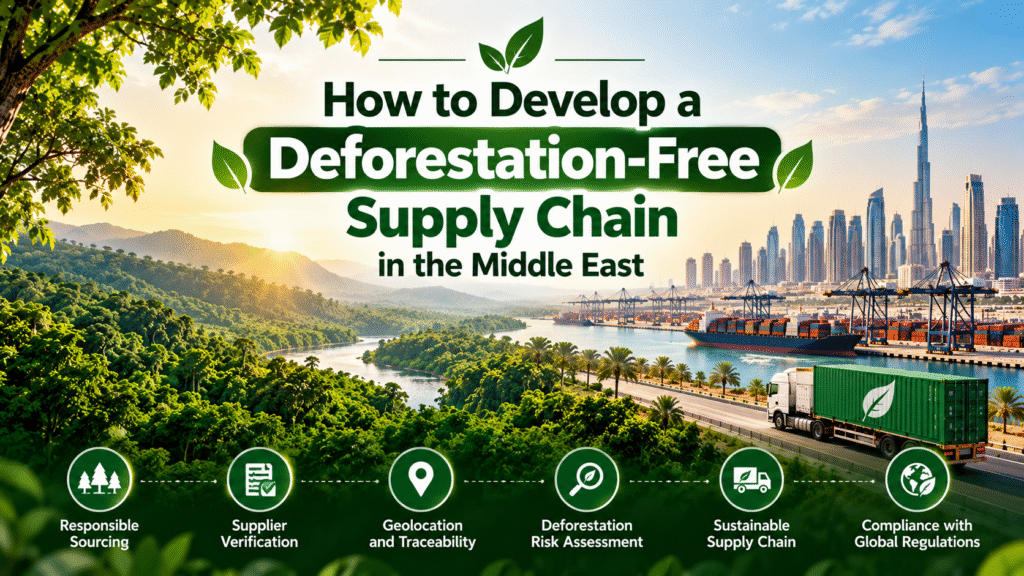
Sustainability has become an important priority for businesses operating in international markets. Companies across the Middle East are increasingly focusing on responsible sourcing, environmental protection, supply chain transparency, and compliance with international sustainability regulations.
As global markets introduce stricter environmental requirements, businesses involved in importing, exporting, manufacturing, and commodity trading must understand the environmental impact of their supply chains. One important area receiving increasing attention is deforestation-free sourcing.
The European Union Deforestation Regulation (EUDR) is an important example of this changing regulatory landscape. It aims to prevent certain commodities and their derived products associated with deforestation and forest degradation from entering or leaving the European Union market.
For Middle Eastern businesses supplying products to European customers, developing a deforestation-free supply chain can help improve regulatory preparedness, strengthen supplier relationships, and support responsible international trade.
Detroit Consultancy provides EUDR compliance and sustainability consulting services to help businesses understand supply chain requirements, assess sourcing risks, improve traceability, and develop effective compliance strategies.
What Is a Deforestation-Free Supply Chain?
A deforestation-free supply chain is a sourcing and production system designed to ensure that relevant raw materials and products are not associated with prohibited deforestation or forest degradation.
It involves monitoring the origin of raw materials, evaluating suppliers, maintaining geographical information, and verifying that sourcing activities meet applicable environmental and legal requirements.
For businesses operating in the Middle East, this approach is particularly important when sourcing commodities from international suppliers or exporting products to markets with strict environmental regulations.
A deforestation-free supply chain generally focuses on:
- Responsible sourcing of raw materials.
- Supplier verification and assessment.
- Geographic origin tracking.
- Deforestation risk assessment.
- Environmental and legal documentation.
- Supply chain traceability.
- Regular monitoring of sourcing practices.
- Compliance with applicable international regulations.
By implementing these practices, businesses can improve supply chain transparency and demonstrate their commitment to environmental responsibility.
Why Is a Deforestation-Free Supply Chain Important for Middle Eastern Businesses?
The Middle East is an important international trading region connecting manufacturers, suppliers, distributors, and customers across Europe, Asia, and Africa.
Businesses in the UAE, Saudi Arabia, Qatar, Oman, Kuwait, and Bahrain often depend on international sourcing networks to obtain raw materials and supply finished products to global markets.
As environmental expectations increase, companies must pay greater attention to the origin and sustainability of their materials.
Here are some important reasons why developing a deforestation-free supply chain matters.
1. Meeting International Environmental Regulations
International regulations increasingly focus on preventing products associated with deforestation from entering regulated markets.
The European Union Deforestation Regulation is an important example. Businesses dealing with covered commodities and derived products must understand the applicable requirements, including production location information, legality verification, and due diligence.
Middle Eastern exporters supplying relevant products to European markets may need to provide supporting information to their EU customers.
2. Improving International Market Access
European and other international buyers increasingly consider environmental responsibility when selecting suppliers.
Companies that maintain transparent sourcing records and demonstrate responsible supply chain practices may be better prepared to meet buyer requirements and maintain business relationships.
3. Strengthening Supplier Relationships
A deforestation-free sourcing strategy encourages businesses to work closely with suppliers and understand their production practices.
Supplier assessments, documentation reviews, and regular communication help businesses identify sourcing risks and establish more reliable partnerships.
4. Reducing Environmental and Commercial Risks
Unverified suppliers and unclear raw material origins can create environmental, regulatory, and commercial risks.
A structured sourcing system helps businesses identify potential problems, improve documentation, and take corrective action where necessary.
5. Supporting Corporate Sustainability Goals
Developing a deforestation-free supply chain demonstrates a commitment to responsible business practices.
It can also support broader Environmental, Social, and Governance (ESG) objectives and sustainability initiatives.
Which Industries in the Middle East Should Focus on Deforestation-Free Supply Chains?
Deforestation-free sourcing is particularly relevant for businesses dealing with commodities covered by EUDR and products derived from them.
The regulation covers seven major commodities:
- Cattle.
- Cocoa.
- Coffee.
- Oil palm.
- Rubber.
- Soya.
- Wood.
It also covers specific products derived from these commodities, depending on their classification under the regulation.
Several industries across the Middle East should assess whether their sourcing and export activities fall within this scope.
1. Timber and Wood Products Industry
Businesses involved in timber trading, furniture manufacturing, wooden packaging, and other covered wood-based products should understand the origin of their raw materials.
They may need to collect information about harvesting locations, geographical coordinates, supplier details, and legal production records.
2. Food Processing and Agricultural Industries
Companies importing or processing relevant commodities such as coffee, cocoa, soya, and palm oil should evaluate their sourcing arrangements.
Food manufacturers and commodity traders may need to obtain additional information from suppliers to establish the origin and compliance status of covered materials.
3. Rubber and Tyre Manufacturing Industry
Rubber and certain rubber-derived products are included in EUDR.
Manufacturers, distributors, and exporters dealing with covered products should evaluate their raw material sourcing and maintain appropriate traceability documentation.
4. Cattle and Leather Products Industry
Businesses involved in relevant cattle-derived products, including certain leather goods, should assess whether their products fall within EUDR requirements.
They may need to establish reliable information about animal production, sourcing locations, and applicable legal requirements.
5. Manufacturing and International Trading Companies
Middle Eastern manufacturers and trading companies often source raw materials from several countries.
Even when manufacturing takes place in the UAE, Saudi Arabia, or another Middle Eastern country, businesses should evaluate whether imported materials fall within the scope of relevant environmental regulations.
Understanding EUDR and Its Role in Deforestation-Free Supply Chains
The European Union Deforestation Regulation (EUDR), established under Regulation (EU) 2023/1115, aims to ensure that specified commodities and derived products placed on or exported from the EU market are not associated with deforestation or forest degradation.
The regulation establishes three fundamental requirements.
1. Deforestation-Free Production
Relevant commodities must not originate from land that was subject to deforestation after 31 December 2020.
For wood products, the regulation also includes requirements relating to forest degradation.
2. Legal Production
Covered commodities must be produced in accordance with applicable legislation in the country of production.
This may involve relevant requirements concerning land use, environmental protection, labour rights, and other applicable legal matters.
3. Due Diligence
Relevant operators must carry out the required due diligence process before placing covered products on the EU market or exporting them from the EU.
This process includes collecting information, assessing risks, and taking appropriate mitigation measures where necessary.
The regulation also requires relevant geographical information about the production plots.
Middle Eastern suppliers outside the EU are not automatically subject to every direct operator obligation. However, European buyers may request detailed sourcing and compliance information from their suppliers to fulfil their own responsibilities.
Understanding these requirements is an important step towards developing a deforestation-free supply chain.
8 Steps to Develop a Deforestation-Free Supply Chain in the Middle East
Developing a deforestation-free supply chain requires a structured approach involving suppliers, manufacturers, procurement teams, and compliance professionals.
Businesses can follow these eight important steps.
Step 1: Identify Relevant Commodities and Products
The first step is to identify whether the raw materials or finished products handled by the business fall within applicable deforestation regulations.
Companies should review their product categories, commodity composition, and relevant customs or product classifications.
For EUDR-related assessments, businesses should specifically check the commodities and product codes listed in Annex I of the regulation.
This helps determine which products require additional sourcing information and compliance checks.
Step 2: Map Your Supply Chain
Supply chain mapping helps businesses understand where raw materials originate and how they move through different stages of production and distribution.
Middle Eastern companies may work with suppliers from multiple countries, making supply chain mapping particularly important.
Businesses should identify:
- Direct suppliers and manufacturers.
- Original producers and raw material sources.
- Countries of production.
- Processing and manufacturing locations.
- Transportation and distribution networks.
- Relevant intermediaries and trading partners.
A clear supply chain map makes it easier to identify information gaps and evaluate potential environmental risks.
Step 3: Verify Supplier Information
Supplier verification is essential for building a transparent and responsible sourcing system.
Businesses should collect relevant information about their suppliers, production locations, sourcing procedures, and applicable legal documentation.
Supplier assessments may include:
- Business registration details.
- Raw material origin records.
- Environmental policies.
- Production and harvesting documentation.
- Relevant permits and approvals.
- Supplier sustainability declarations.
- Applicable certifications and audit records.
Companies should also establish procedures for verifying the accuracy and reliability of the information received.
Step 4: Collect Geolocation Data
Geolocation data is an important requirement under EUDR.
It identifies the geographical locations of the land plots where relevant commodities were produced.
Businesses may use GPS-based tools, geographical information systems (GIS), satellite mapping, and other suitable technologies to collect and organise geographical information.
Accurate geolocation information helps businesses connect raw materials with their original production locations and evaluate potential deforestation risks.
Middle Eastern exporters sourcing covered commodities from international suppliers should establish clear procedures for obtaining this information.
Step 5: Conduct Deforestation Risk Assessment
After collecting supplier and geographical information, businesses should evaluate potential deforestation risks within their sourcing networks.
Risk assessment may include:
- Reviewing satellite imagery.
- Checking historical land-use information.
- Evaluating production locations.
- Reviewing supplier documentation.
- Assessing the reliability of geographical data.
- Identifying possible inconsistencies in sourcing records.
- Considering relevant country and commodity risks.
For EUDR compliance, risk assessment must follow the applicable regulatory requirements. Where risks are identified, businesses should implement appropriate mitigation measures.
Step 6: Establish Responsible Sourcing Policies
Businesses should develop clear sourcing policies that explain their environmental expectations and supplier responsibilities.
A responsible sourcing policy may cover:
- Deforestation-free sourcing commitments.
- Supplier environmental responsibilities.
- Legal production requirements.
- Traceability procedures.
- Documentation requirements.
- Supplier monitoring.
- Corrective action procedures.
These policies should be communicated to suppliers, procurement teams, and relevant business partners.
Step 7: Implement a Supply Chain Monitoring System
Deforestation-free sourcing should not be treated as a one-time assessment.
Businesses need ongoing procedures to review supplier information, monitor sourcing changes, and maintain updated records.
A supply chain monitoring system can help companies:
- Track supplier information.
- Maintain geographical records.
- Review sourcing documentation.
- Identify compliance gaps.
- Monitor corrective actions.
- Maintain product traceability.
- Prepare information for customer assessments.
Digital supply chain management systems can make this process more efficient, particularly for businesses working with multiple suppliers.
Step 8: Maintain Compliance Documentation
Proper documentation helps businesses demonstrate their sourcing practices and respond to information requests from international buyers.
Depending on the product and applicable requirements, records may include:
- Supplier identification information.
- Raw material origin documents.
- Geolocation records.
- Production and harvesting information.
- Legal permits and approvals.
- Risk assessment reports.
- Supplier verification records.
- Due diligence supporting information.
Relevant records should be maintained in an organised and accessible format.
Challenges in Developing Deforestation-Free Supply Chains in the Middle East
Businesses across the Middle East may face several challenges when implementing responsible sourcing and environmental compliance procedures.
1. Complex International Sourcing Networks
Many companies source raw materials from suppliers located in different countries.
Tracking the origin of every relevant commodity can become difficult when products pass through multiple traders, processors, and distributors.
2. Incomplete Supplier Documentation
Some suppliers may not maintain sufficient information about production locations, raw material origins, or environmental practices.
This can create difficulties when businesses need to demonstrate sourcing transparency.
3. Limited Access to Geolocation Information
Obtaining accurate geographical coordinates can be challenging, particularly when sourcing from multiple farms, plantations, or production areas.
4. Different Regulatory Requirements
Businesses exporting to Europe, the United Kingdom, the United States, and other markets may need to understand different environmental and product compliance requirements.
Managing these requirements across several markets requires proper planning and documentation.
5. Lack of Integrated Traceability Systems
Companies relying on manual records and spreadsheets may find it difficult to track large volumes of materials and supplier information.
Digital traceability solutions can help improve information management and reduce administrative challenges.
6. Supplier Awareness and Training
Not every supplier understands international deforestation regulations or environmental sourcing expectations.
Businesses may need to provide guidance and establish clear communication procedures to improve supplier participation.
How Detroit Consultancy Helps Businesses Develop Deforestation-Free Supply Chains
Detroit Consultancy provides sustainability consulting and EUDR compliance support to businesses looking to improve supply chain transparency and prepare for international environmental regulations.
Our approach focuses on understanding business operations, evaluating sourcing practices, identifying compliance gaps, and developing practical improvement strategies.
1. EUDR Compliance Assessment
We help businesses understand how EUDR applies to their products, suppliers, and supply chain activities.
Our assessment can cover product classification, supplier documentation, traceability arrangements, geolocation data availability, and relevant due diligence requirements.
2. Supply Chain Mapping and Traceability
Detroit Consultancy supports businesses in reviewing their supply chain structures and improving visibility into sourcing networks.
This includes identifying suppliers, raw material origins, production locations, and relevant documentation requirements.
3. Geolocation and Mapping Support
We help businesses understand geographical information requirements and establish appropriate processes for collecting, organising, and reviewing production-location data.
This supports better sourcing transparency and deforestation risk assessment.
4. Deforestation Risk Assessment
Our consulting approach helps businesses identify potential environmental risks associated with relevant raw material sourcing.
This may involve reviewing geographical information, supplier records, satellite-based information, and available environmental documentation.
5. Supplier Compliance Assessment
We help companies establish supplier assessment procedures and identify the information needed to evaluate sourcing practices.
This can include reviewing supplier declarations, environmental policies, legal documentation, and traceability records.
6. Sustainability Consulting
Detroit Consultancy also supports businesses with broader sustainability initiatives, including environmental risk assessments, responsible sourcing strategies, and supply chain improvement planning.
Our goal is to help companies strengthen environmental responsibility while preparing for international business requirements.
7. Documentation and Due Diligence Support
We assist businesses in understanding the documentation required for their applicable compliance processes.
This may include supplier records, commodity origin information, geolocation documentation, risk assessment reports, and supporting due diligence information.
The legally responsible operator remains responsible for completing and submitting any required EUDR due diligence statement.
Benefits of Developing a Deforestation-Free Supply Chain
Implementing a deforestation-free supply chain can offer several benefits for Middle Eastern businesses.
- Better Regulatory Preparedness: Understand relevant environmental regulations and prepare the necessary supporting information.
- Improved Supply Chain Transparency: Gain better visibility into suppliers, production locations, and raw material origins.
- Stronger International Relationships: Respond more effectively to sourcing and sustainability requests from international buyers.
- Reduced Environmental Risks: Identify potential deforestation-related issues and improve sourcing practices.
- Better Supplier Management: Establish clear expectations and improve communication with business partners.
- Improved Sustainability Performance: Support responsible sourcing and broader environmental objectives.
- Greater Business Competitiveness: Demonstrate a commitment to transparency and responsible international trade.
For companies operating in competitive international markets, these benefits can contribute to stronger business relationships and long-term operational resilience.
Why Choose Detroit Consultancy for EUDR and Sustainability Consulting?
Developing a deforestation-free supply chain requires a clear understanding of international regulations, sourcing practices, geographical information, and supplier management.
Detroit Consultancy supports businesses with practical sustainability and compliance consulting services designed around their operational and market requirements.
Our services include:
- EUDR compliance consulting.
- Supply chain traceability support.
- Deforestation risk assessment.
- Geolocation data requirements support.
- Supplier compliance assessments.
- Responsible sourcing strategies.
- Sustainability gap assessments.
- Due diligence documentation support.
- Environmental compliance consulting.
Whether your business operates in the UAE, Saudi Arabia, Qatar, Oman, Kuwait, or Bahrain, our consulting approach can help you understand relevant environmental requirements and improve your supply chain management practices.
Developing a deforestation-free supply chain is becoming an important priority for businesses involved in international sourcing, manufacturing, and exports.
For Middle Eastern companies, responsible sourcing involves more than selecting reliable suppliers. It requires understanding raw material origins, maintaining geographical information, assessing environmental risks, verifying supplier documentation, and following applicable international regulations.
The European Union Deforestation Regulation has further increased the importance of supply chain transparency for businesses dealing with covered commodities and products.
By adopting structured sourcing policies, supplier assessments, traceability systems, and risk management procedures, companies can strengthen their environmental practices and prepare for changing international market expectations.
Detroit Consultancy provides EUDR compliance and sustainability consulting services to help Middle Eastern businesses improve supply chain transparency, assess deforestation risks, and develop responsible sourcing strategies.
Contact Detroit Consultancy to discuss your supply chain compliance requirements and take the next step towards building a more sustainable and transparent supply chain.
Frequently Asked Questions (FAQs)
1. What is a deforestation-free supply chain?
A deforestation-free supply chain is a sourcing and production system designed to ensure that relevant commodities and products are not associated with prohibited deforestation or forest degradation. It involves supplier verification, traceability, geographical information, and environmental risk assessment.
2. Why is EUDR important for Middle Eastern businesses?
EUDR is important for Middle Eastern businesses that supply covered commodities and derived products to European markets. EU buyers may require detailed information about product origins, production locations, legality, and deforestation-free sourcing.
3. Which commodities are covered by EUDR?
EUDR covers cattle, cocoa, coffee, oil palm, rubber, soya, and wood, along with specific products derived from these commodities as listed in the regulation.
4. How can businesses identify deforestation risks in their supply chains?
Businesses can identify potential deforestation risks by reviewing supplier information, production locations, geographical coordinates, satellite imagery, historical land-use records, and relevant environmental documentation.
5. What is geolocation data in EUDR compliance?
Geolocation data refers to geographical coordinates identifying the land plots where relevant commodities were produced. It helps businesses and responsible operators verify product origins and assess deforestation risks.
6. Do Middle Eastern exporters need EUDR certification?
EUDR does not establish a general certification that automatically makes a business compliant. Relevant operators must fulfil the regulation’s due diligence requirements. Non-EU suppliers may need to provide supporting information to their European customers.
7. How can a business improve supply chain traceability?
Businesses can improve traceability by mapping suppliers, recording raw material origins, collecting production-location information, maintaining purchasing and processing records, and implementing digital supply chain management systems.
8. How can Detroit Consultancy help develop a deforestation-free supply chain?
Detroit Consultancy supports businesses through EUDR compliance assessments, supplier verification, supply chain mapping, geolocation support, deforestation risk assessment, sustainability consulting, and due diligence documentation support.