
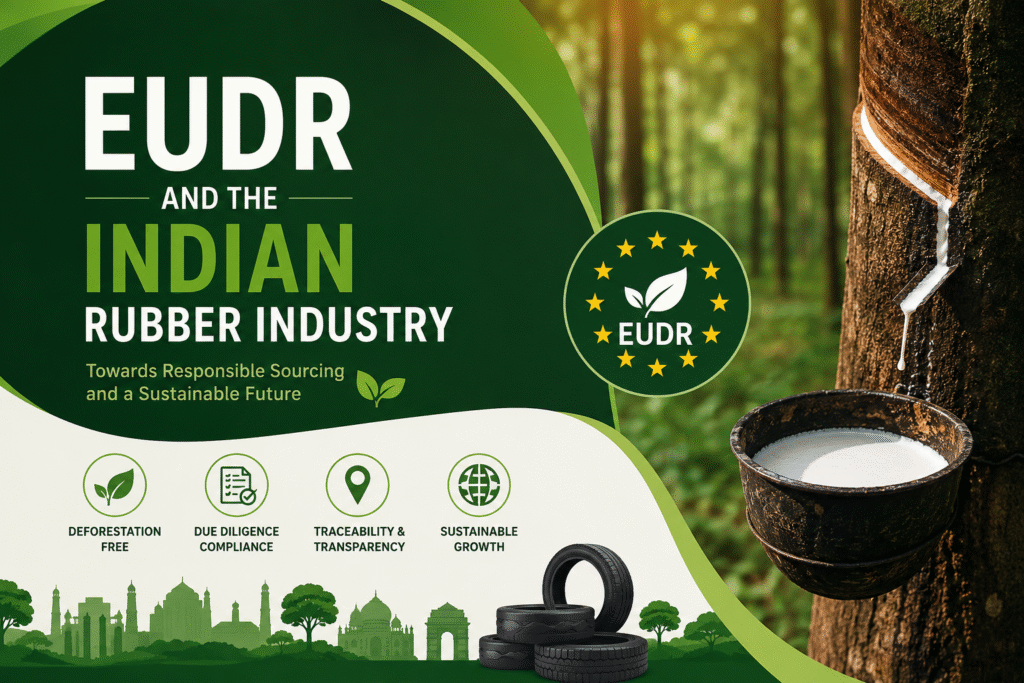
EUDR and the Indian Rubber Industry: A Practical Compliance Roadmap for Kerala and Southern India
The European Union Deforestation Regulation (EUDR) is fundamentally changing how natural rubber is sourced, processed, and exported to the European Union. While much of the discussion has focused on timber and palm oil, the implications for India’s rubber sector—particularly in Kerala and Southern India—are equally significant.
India’s rubber supply chain is unique. Unlike many producing countries where plantations are dominated by large estates, India’s rubber economy is built on thousands of smallholders, estate owners, processors, aggregators, and manufacturers working together. This fragmented supply chain makes EUDR compliance both challenging and achievable—provided every participant understands their role.
The key to successful compliance is recognizing that EUDR responsibilities differ for each stakeholder in the value chain.
Understanding India’s Rubber Supply Chain
The Indian rubber industry can broadly be divided into four segments:
- Smallholder rubber farmers
- Estate owners and plantation operators
- Aggregators and rubber processors
- Rubber product manufacturers and exporters
Each of these participants contributes differently to the Due Diligence System (DDS) required under EUDR.
1. Small Rubber Farmers: The Foundation of Compliance
A significant portion of India’s natural rubber is produced by small farmers owning relatively small plantations.
These farmers usually harvest latex and sell it directly to local collection centres, traders, or processors.
For these farmers, EUDR compliance is relatively straightforward.
They primarily need to provide:
- Accurate farm ownership details
- Geolocation coordinates of the plantation
- Details of the cultivated rubber plot
- Identity documentation wherever required by the buyer
Once their plantation has been geo-mapped and linked to their supplier profile, the information can be reused for future transactions, provided there are no changes in land ownership or cultivation.
For most smallholders, geo-location becomes their primary contribution to the EUDR compliance chain.
2. Estate Owners: Moving Beyond Geolocation
Large plantation owners have greater compliance responsibilities.
Simply providing GPS coordinates is no longer sufficient.
Estate operators should develop a structured plantation compliance system that includes:
- Geo-mapping of every plantation block
- Plantation boundary verification
- Plantation reports
- Production records
- Harvest traceability
- Internal documentation supporting EUDR due diligence
These plantation reports become critical evidence supporting the Due Diligence Statement (DDS) generated later in the supply chain.
Well-documented estates significantly reduce compliance risks for downstream processors and exporters.
3. Rubber Processors and Aggregators: The Most Critical Link
Processors occupy the most complex position in the EUDR supply chain.
They procure latex from:
- Thousands of small farmers
- Estate owners
- Village collection centres
- Dedicated procurement routes
Most processors already operate structured milk-run collection systems.
Typically, they:
- Supply empty latex collection barrels to farmers.
- Farmers fill these containers over a defined period.
- The processor follows scheduled routes to collect filled barrels.
- Empty containers are replaced for the next collection cycle.
Interestingly, this existing logistics model can become the backbone of EUDR traceability.
Every procurement route already contains valuable operational information, including:
- Farmer identity
- Collection location
- Collection date
- Quantity collected
- Route mapping
Instead of treating these as only logistics records, processors should integrate them into an EUDR-compliant supplier database.
Each farmer supplying latex should have:
- Registered supplier profile
- Verified geo-location
- Plantation information
- Digital records linked to procurement routes
Using dedicated EUDR-compatible geolocation software and verified mapping tools, processors can establish a reliable supplier database that supports future DDS generation.
This significantly simplifies compliance while improving procurement transparency.
Lot-Based EUDR Compliance
One of the most practical approaches for processors is to manufacture EUDR-compliant production lots.
For example, a processor producing ten lots of 25 tonnes each may choose to dedicate selected lots exclusively to EUDR-compliant raw material.
These compliant lots can then be sold separately to manufacturers supplying European markets.
This approach provides several operational benefits:
- Easier inventory management
- Simplified traceability
- Lower compliance risk
- Faster DDS preparation
- Better commercial value for compliant rubber
Rather than attempting to convert the entire production into EUDR material immediately, processors can gradually increase the proportion of DDS-supported production lots.
Maintaining Material Integrity
Perhaps the biggest operational challenge under EUDR is maintaining product integrity.
Processors may simultaneously manufacture:
- EUDR-compliant natural rubber
- Conventional natural rubber
These materials should never be mixed unintentionally.
Good industry practice requires:
- Physical segregation of compliant and non-compliant inventory
- Separate storage locations
- Clear batch identification
- Material movement records
- Input-output reconciliation
- Inventory balance verification
At the end of each reporting period, processors should be able to demonstrate that the quantity of EUDR-compliant material sold is supported by the quantity of compliant raw material purchased.
This mass-balance verification is essential to maintaining the credibility of the Due Diligence System.
Building a Long-Term Supplier Database
Processors should establish dedicated field teams responsible for supplier onboarding.
Their responsibilities should include:
- Farmer registration
- Geo-location collection
- Plantation verification
- Record updates
- Digital database maintenance
A continuously updated supplier database reduces future compliance effort while strengthening long-term procurement relationships.
Over time, this becomes one of the processor’s most valuable compliance assets.
4. Rubber Product Manufacturers and Exporters
The final responsibility rests with manufacturers producing finished rubber goods for export.
These may include manufacturers of:
- Tyres
- Industrial rubber products
- Medical products
- Rubber footwear
- Automotive components
- Engineering rubber goods
Although they purchase processed natural rubber rather than raw latex, they remain responsible for EUDR compliance when exporting products covered by the regulation.
Every export consignment destined for the EU requires a Due Diligence Statement (DDS) demonstrating that the products originate from compliant sources.
Manufacturers sourcing rubber from processors that already supply DDS-supported material gain a significant advantage.
Their compliance process becomes considerably simpler because much of the upstream due diligence has already been completed.
Rather than recreating supplier verification from scratch, they can build their export DDS using verified upstream documentation.
Why OEMs Should Demand DDS-Supported Raw Material
Many buyers currently ask suppliers whether their products are “EUDR compliant.”
However, compliance claims alone are insufficient.
Manufacturers should instead insist on receiving DDS-supported consignments.
A processor supplying verified DDS-linked lots provides:
- Verified geolocation records
- Supplier traceability
- Plantation evidence
- Procurement documentation
- Batch traceability
This dramatically reduces the compliance burden on the manufacturer while improving confidence throughout the supply chain.
In practice, DDS-supported procurement is likely to become the preferred commercial standard for European exports.
A Collaborative Approach to EUDR
The Indian rubber industry already possesses many of the operational systems necessary for EUDR compliance.
Collection routes, farmer networks, plantation records, procurement schedules, and batch production systems all provide a strong foundation.
The challenge is not creating entirely new systems—it is integrating existing operational practices into a structured Due Diligence System supported by verified geolocation, traceability, documentation, and digital recordkeeping.
For Kerala and Southern India, where natural rubber forms the backbone of thousands of livelihoods, EUDR should not be viewed merely as another regulatory obligation. Instead, it presents an opportunity to modernize supply chains, strengthen traceability, enhance buyer confidence, and position Indian natural rubber as a trusted, responsibly sourced material in global markets.
Organizations that begin building robust DDS-supported supply chains today will be better positioned to meet European market expectations, reduce compliance risks, and create long-term commercial value in an increasingly sustainability-driven global economy.
Need help preparing your rubber supply chain for EUDR? Detroit Consultancy supports rubber processors, estate owners, exporters, and manufacturers with end-to-end EUDR implementation, including supplier onboarding, geolocation mapping, Due Diligence Statement (DDS) preparation, risk assessment, traceability systems, and export compliance. Whether you are exporting natural rubber, technical rubber products, or finished goods to Europe, our team can help you build a compliant and audit-ready supply chain. Contact Detroit Consultancy today to schedule an EUDR readiness assessment.