
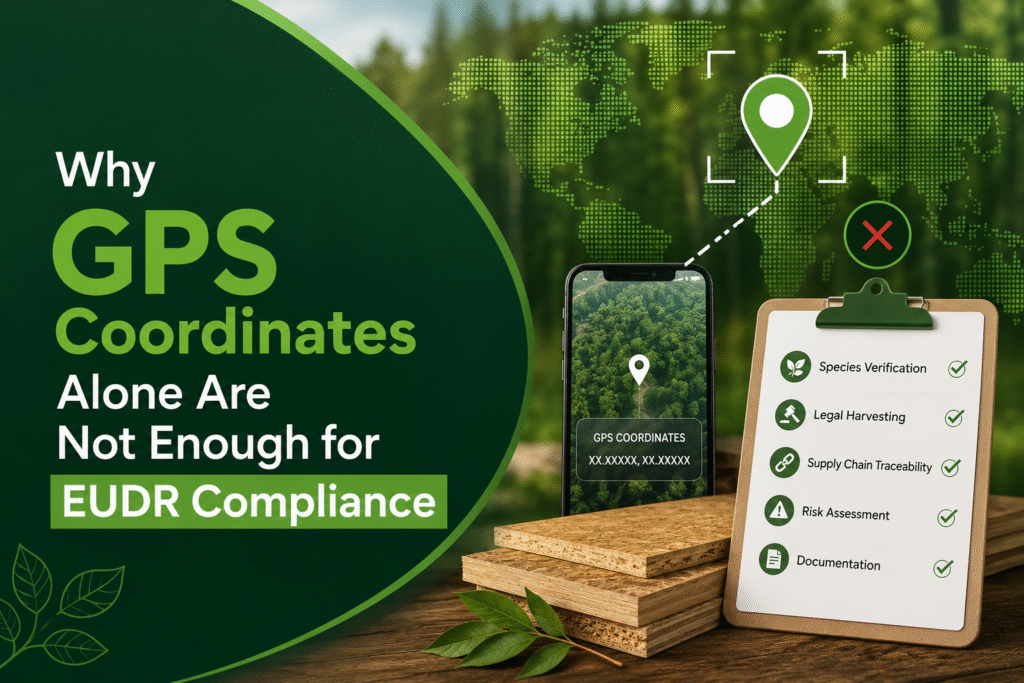
As the European Union Deforestation Regulation (EUDR) moves from policy to implementation, many exporters have started collecting GPS coordinates of farms and forest plots, believing that this completes the geolocation requirement.
Unfortunately, this is one of the most common misconceptions in EUDR compliance.
A latitude and longitude coordinate is only a location reference. By itself, it does not demonstrate compliance, confirm legality, or establish whether the sourcing area meets EUDR expectations. The real challenge begins after the coordinates have been collected.
Understanding this distinction can make the difference between a smooth Due Diligence Statement (DDS) submission and a costly compliance delay.
Collecting Coordinates Is Easy. Building Confidence Around Them Is Not.
Today, GPS-enabled mobile devices, mapping applications and publicly available satellite imagery allow almost anyone to capture geographical coordinates.
However, EUDR requires far more than identifying a point on a map.
The quality of geolocation data depends on several factors, including the accuracy of the captured location, consistency with supporting documents, the correct representation of land boundaries, and the ability to assess potential deforestation-related risks associated with that location.
In other words, a coordinate without proper verification is simply a number.
Why Risk Assessment Matters
Once a geolocation is available, the next question is far more important:
What does this location tell us about the land from which the commodity originated?
This is where professional risk assessment becomes essential.
Modern EUDR implementation relies on advanced geospatial analysis, satellite imagery and digital risk assessment methodologies to understand whether a sourcing area requires additional due diligence.
These assessments help identify factors that may require closer examination, enabling businesses to make informed compliance decisions before submitting a DDS.
What Happens When a Location Appears High Risk?
Many companies assume that a higher initial risk assessment automatically means the land is unsuitable for EUDR compliance.
That is not necessarily the case.
An initial risk indication should be treated as the beginning of a structured due diligence process—not the end of it.
Experienced compliance professionals investigate further by analysing the available evidence and determining whether the identified risks can be appropriately assessed and addressed through additional documentation and technical evaluation.
This is where expertise becomes significantly more valuable than technology alone.
Looking Beyond the Coordinates
A comprehensive EUDR due diligence process should evaluate multiple dimensions rather than relying on a single map result.
These may include:
- Geolocation validation and accuracy review.
- Historical satellite imagery analysis over multiple years.
- AI-assisted land interpretation to identify observable land-use patterns.
- Country-specific legality considerations.
- Regional and commodity-specific risk factors.
- Supply chain documentation.
- Chain of Custody verification.
- Supporting evidence demonstrating legal sourcing and traceability.
Each element contributes to a more complete understanding of the sourcing location and supports an informed compliance decision.
Technology Provides Data. Professionals Provide Interpretation.
One of the biggest misunderstandings surrounding EUDR is that software alone can determine compliance.
Technology is an essential enabler, but compliance decisions still depend on informed analysis.
A digital platform can identify potential areas requiring attention. However, interpreting those findings alongside legal documentation, procurement records, traceability evidence and Chain of Custody information requires practical experience and regulatory understanding.
This combination of technology and professional judgement is what transforms raw data into a robust Due Diligence Statement.
A Structured Approach to EUDR Implementation
At Detroit Consultancy, we believe successful EUDR compliance requires an integrated implementation framework rather than isolated compliance activities.
Our approach combines structured geolocation collection methodologies with advanced digital traceability, systematic risk assessment and comprehensive document verification.
Working alongside the Dilify digital platform, we support businesses throughout the due diligence journey—from geolocation collection and supply chain mapping to risk evaluation, documentation review and DDS preparation.
Where additional review is necessary, our specialists perform deeper assessments using historical imagery, AI-assisted analysis, country and regional legality evaluations, commodity-specific considerations and supporting Chain of Custody records to build a well-documented compliance position.
This structured methodology helps organisations make informed decisions with confidence while maintaining consistent and transparent compliance records.
Why Businesses Choose an Integrated Compliance Framework
EUDR is not simply about submitting a declaration. It is about demonstrating that every conclusion is supported by reliable evidence.
An integrated framework helps organisations:
- Improve the quality of geolocation records.
- Strengthen supply chain transparency.
- Enhance documentation consistency.
- Reduce manual compliance efforts.
- Build greater confidence before DDS submission.
- Prepare for customer reviews and regulatory scrutiny.
For organisations managing multiple suppliers, commodities and export consignments, this structured approach can significantly improve operational efficiency and compliance readiness.
How Detroit Consultancy Supports Exporters
Detroit Consultancy works with manufacturers, exporters and supply chain partners to design practical EUDR implementation systems that align with day-to-day business operations.
Our services include:
- EUDR readiness assessments.
- Geolocation collection frameworks.
- Supply chain traceability design.
- Chain of Custody implementation.
- Risk assessment support.
- Documentation verification.
- Training for procurement, production and export teams.
- End-to-end DDS preparation through the Dilify platform.
We support organisations across Delhi NCR, Mumbai, Kolkata, Hyderabad, Bengaluru and Ahmedabad, as well as exporters throughout India who are preparing their supply chains for European market access.
The success of an EUDR Due Diligence Statement is not determined by whether a business can collect GPS coordinates. It is determined by how effectively those coordinates are verified, analysed and supported with credible evidence.
As EUDR expectations continue to evolve, organisations that combine reliable digital technology with experienced implementation support will be better equipped to manage risk, demonstrate transparency and maintain access to international markets.
At Detroit Consultancy, our objective is not simply to help businesses generate a DDS. Our objective is to help them build a traceability system that stands up to scrutiny—today and as regulatory expectations continue to develop.