
The palm oil industry plays a major role in the global economy. Palm oil is one of the most widely used vegetable oils in the world and is found in thousands of everyday products, including food items, cosmetics, personal care products, detergents, pharmaceuticals, and biofuels. Due to its high productivity and versatility, palm oil remains a key agricultural commodity for many countries and industries.
However, the industry has also faced increasing global scrutiny because of concerns related to deforestation, environmental degradation, greenhouse gas emissions, labor rights violations, and biodiversity loss. As sustainability expectations continue to rise, Environmental, Social, and Governance (ESG) practices have become essential for palm oil companies seeking long-term growth, global market access, investor confidence, and regulatory compliance.
Today, ESG is no longer just a corporate responsibility initiative. It has become a critical business strategy for palm oil producers, exporters, processors, and supply chain stakeholders. Governments, investors, buyers, and consumers are now demanding transparency, ethical sourcing, traceability, and sustainable operations across the palm oil supply chain.
This blog explains the importance of ESG in the palm oil industry, the key challenges businesses face, the role of sustainability regulations, and how companies can build responsible and future-ready palm oil operations.
Understanding ESG in the Palm Oil Industry
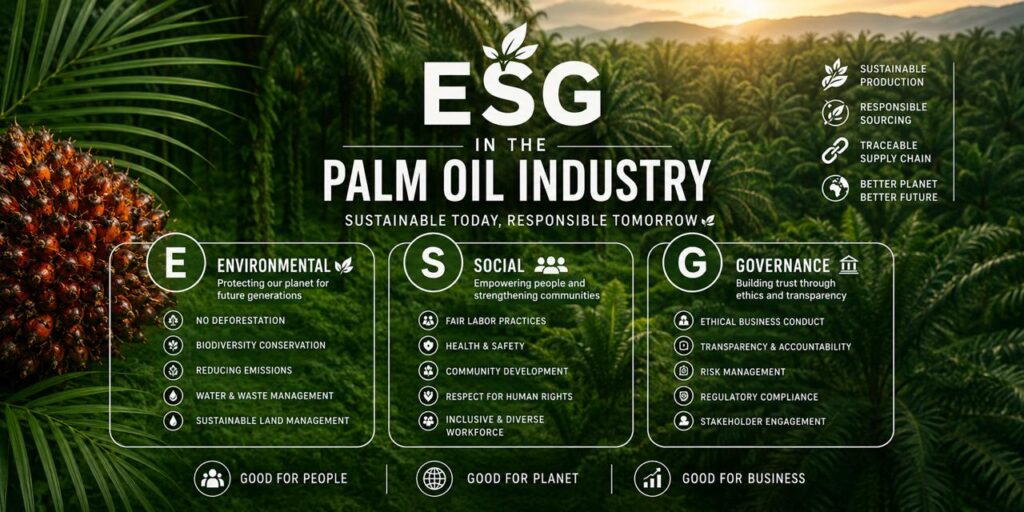
ESG stands for Environmental, Social, and Governance. These three pillars help evaluate how responsibly a company operates and manages its impact on the environment, society, and business ethics.
In the palm oil industry, ESG focuses on reducing environmental damage, improving social responsibility, and strengthening corporate governance systems.
The three ESG pillars include:
Environmental (E)
The environmental aspect focuses on how palm oil companies manage their impact on forests, biodiversity, climate, water, and natural ecosystems.
Key environmental concerns include:
- Deforestation
- Land-use change
- Greenhouse gas emissions
- Soil degradation
- Water pollution
- Biodiversity loss
- Waste management
Palm oil companies are expected to adopt sustainable cultivation and production practices that minimize environmental harm.
Social (S)
The social component addresses the relationship between businesses, workers, local communities, and stakeholders.
Social ESG factors include:
- Labor rights
- Worker safety
- Fair wages
- Human rights protection
- Community engagement
- Indigenous land rights
- Gender equality
- Ethical sourcing
The palm oil industry has faced criticism regarding labor exploitation and land conflicts, making social responsibility increasingly important.
Governance (G)
Governance focuses on how companies are managed, monitored, and regulated.
Governance principles include:
- Ethical business practices
- Compliance systems
- Risk management
- Anti-corruption measures
- Transparency
- Board accountability
- Supply chain oversight
Strong governance improves operational integrity and investor confidence.
Why ESG is Important in the Palm Oil Industry
The palm oil sector is under growing pressure from regulators, international buyers, investors, and environmental organizations.
Businesses that fail to address ESG risks may face:
- Export restrictions
- Buyer rejection
- Reputational damage
- Legal penalties
- Loss of investor trust
- Reduced market access
At the same time, companies with strong ESG performance can gain significant competitive advantages.
Increasing Global Sustainability Expectations
Consumers today are more aware of environmental and ethical issues associated with agricultural commodities. Global brands now prefer sourcing palm oil from sustainable suppliers that can demonstrate ESG compliance and traceability.
This shift is driving palm oil companies to adopt responsible sourcing policies and sustainability frameworks.
Impact of International Regulations
Regulations such as the European Union Deforestation Regulation (EUDR) are making ESG compliance essential for international trade.
Under EUDR, palm oil exporters must prove that their products are:
- Deforestation-free
- Legally produced
- Fully traceable
- Sustainably sourced
This regulation directly connects ESG performance with export eligibility.
Investor and Financial Pressure
Investors increasingly use ESG ratings when evaluating companies.
Banks and financial institutions now assess sustainability risks before providing funding or investment support.
Palm oil businesses with poor ESG performance may struggle to secure financing or partnerships.
Brand Reputation and Market Access
Sustainability has become a major factor influencing purchasing decisions.
Global food manufacturers, retailers, and cosmetic brands want to avoid supply chain risks associated with unsustainable palm oil.
Companies with strong ESG practices are more likely to attract premium buyers and long-term business opportunities.
Environmental Challenges in the Palm Oil Industry
The environmental pillar remains one of the most discussed ESG topics in the palm oil sector.
Deforestation Concerns
Palm oil cultivation has historically been associated with tropical deforestation in some regions.
Forest clearing for plantation expansion can lead to:
- Habitat destruction
- Carbon emissions
- Biodiversity loss
- Ecosystem imbalance
Governments and buyers are now demanding deforestation-free supply chains.
Biodiversity Loss
Palm oil plantations developed in ecologically sensitive areas can threaten wildlife species, including endangered animals.
Protecting biodiversity has become a major sustainability objective.
Companies are increasingly adopting conservation policies and no-deforestation commitments.
Carbon Emissions and Climate Change
Land-use changes and peatland development can contribute significantly to greenhouse gas emissions.
Palm oil companies are expected to reduce their carbon footprint by:
- Preventing deforestation
- Improving land management
- Reducing waste emissions
- Using renewable energy
- Implementing climate-smart agriculture
Water and Soil Management
Unsustainable agricultural practices can affect soil quality and water resources.
Responsible plantation management should include:
- Water conservation
- Soil protection
- Sustainable fertilizer use
- Wastewater treatment
- Pollution prevention
Environmental sustainability improves long-term productivity and reduces operational risks.
Social Responsibility in the Palm Oil Industry
Social sustainability is becoming increasingly important for palm oil companies.
Labor Rights and Worker Welfare
The industry has faced criticism regarding labor conditions in some supply chains.
Responsible businesses must ensure:
- Safe working environments
- Fair wages
- Legal employment practices
- Worker health and safety
- No forced labor
- No child labor
Strong labor standards improve workforce stability and brand credibility.
Community Engagement
Palm oil plantations often operate near local communities and indigenous populations.
Companies should maintain transparent relationships with communities through:
- Stakeholder consultations
- Community development programs
- Education initiatives
- Healthcare support
- Employment opportunities
Positive community relations reduce social conflicts and improve operational stability.
Indigenous Land Rights
Land disputes remain a challenge in some palm oil-producing regions.
Responsible companies must respect:
- Traditional land ownership
- Indigenous rights
- Free, Prior, and Informed Consent (FPIC)
Ethical land acquisition practices are essential for ESG compliance.
Governance Practices for Sustainable Palm Oil Businesses
Strong governance systems support long-term sustainability and compliance.
Transparency and Traceability
Traceability has become one of the most important governance requirements.
Palm oil companies must be able to track products from plantation to final buyer.
Transparent supply chains help businesses:
- Meet EUDR requirements
- Build buyer confidence
- Reduce sourcing risks
- Improve accountability
Digital traceability systems are now widely used across the industry.
Anti-Corruption and Ethical Business Conduct
Governance frameworks should include anti-corruption policies and ethical sourcing standards.
Businesses must maintain clear compliance procedures for:
- Procurement
- Supplier management
- Financial reporting
- Regulatory compliance
Ethical governance strengthens stakeholder trust.
Risk Management Systems
Palm oil companies face multiple operational and sustainability risks.
Governance systems should monitor:
- Environmental risks
- Supply chain risks
- Legal compliance
- Reputational risks
- Human rights concerns
Proactive risk management improves business resilience.
ESG and Sustainable Palm Oil Certifications
Certifications help companies demonstrate sustainability commitments and improve market acceptance.
RSPO Certification
The Roundtable on Sustainable Palm Oil (RSPO) is one of the most recognized sustainability certifications in the palm oil industry.
RSPO certification promotes:
- Responsible cultivation
- Environmental protection
- Ethical labor practices
- Supply chain transparency
Many international buyers prefer RSPO-certified suppliers.
ISPO and MSPO Standards
Countries such as Indonesia and Malaysia have introduced national sustainability standards including:
- Indonesian Sustainable Palm Oil (ISPO)
- Malaysian Sustainable Palm Oil (MSPO)
These certifications support sustainable production practices and regulatory compliance.
Importance of Certification
Certifications help businesses:
- Improve buyer trust
- Access international markets
- Strengthen ESG performance
- Enhance brand reputation
- Reduce compliance risks
However, certifications alone may not guarantee EUDR compliance, making traceability and due diligence equally important.
ESG and EUDR Compliance
The connection between ESG and EUDR is becoming increasingly strong.
EUDR requires companies to prove that palm oil products are not linked to deforestation or illegal land use.
This means businesses must implement ESG systems that support:
- Environmental monitoring
- Supply chain transparency
- Risk assessment
- Supplier accountability
- Sustainability reporting
Companies with strong ESG programs are generally better prepared for EUDR compliance.
Role of Technology in ESG Implementation
Technology is transforming ESG management in the palm oil industry.
Satellite Monitoring and GIS Mapping
Satellite technology helps companies monitor:
- Forest cover
- Land-use changes
- Deforestation risks
- Plantation boundaries
GIS mapping improves geolocation accuracy and compliance reporting.
Blockchain Traceability
Blockchain systems create transparent supply chain records that cannot be easily altered.
This improves traceability and accountability across sourcing networks.
Artificial Intelligence and Data Analytics
AI tools help businesses analyze large volumes of environmental and operational data.
AI can support:
- Risk detection
- Predictive analysis
- Compliance monitoring
- Sustainability reporting
Technology-driven ESG systems improve operational efficiency and decision-making.
Benefits of ESG Adoption in the Palm Oil Industry
Improved Market Access
Many international buyers now require ESG compliance before sourcing palm oil products.
Sustainable companies gain better access to global markets.
Stronger Investor Confidence
Investors prefer businesses with lower sustainability risks and stronger governance structures.
Good ESG performance can improve funding opportunities and business valuation.
Better Brand Reputation
Consumers increasingly support environmentally and socially responsible brands.
Sustainable palm oil companies can strengthen customer trust and brand loyalty.
Reduced Operational Risks
ESG systems help identify and mitigate environmental, legal, and reputational risks early.
This improves long-term business stability.
Regulatory Readiness
Businesses with ESG systems are better prepared for evolving regulations such as:
- EUDR
- Carbon disclosure requirements
- Sustainability reporting frameworks
- Supply chain due diligence laws
Early preparation reduces future compliance challenges.
Challenges in ESG Implementation
Despite the benefits, palm oil companies may face several ESG implementation challenges.
High Compliance Costs
Sustainability systems, audits, certifications, and traceability technologies require investments.
Smaller businesses may struggle with financial constraints.
Complex Supply Chains
Palm oil supply chains often involve multiple intermediaries and smallholder farmers.
Collecting accurate traceability data can be difficult.
Lack of Awareness and Training
Many stakeholders still lack knowledge about ESG requirements and sustainability practices.
Training and capacity-building programs are essential.
Data Management Difficulties
Managing environmental, social, and compliance data across large operations can be complex.
Digital systems are increasingly necessary for effective ESG management.
Future of ESG in the Palm Oil Industry
The future of the palm oil industry will be heavily influenced by sustainability expectations and ESG regulations.
In the coming years, businesses can expect:
- Stronger traceability requirements
- Increased ESG reporting obligations
- Greater investor scrutiny
- Expansion of deforestation regulations
- More climate-focused policies
- Higher consumer expectations
Sustainability will become a core business requirement rather than a voluntary initiative.
Companies that adopt ESG proactively will be better positioned for long-term growth and international competitiveness.
How Detroit Consultancy Supports ESG Compliance
Detroit Consultancy helps palm oil companies strengthen sustainability and ESG performance through professional consulting services.
Services may include:
- ESG assessments
- EUDR compliance support
- Sustainability strategy development
- Traceability implementation
- Risk assessments
- Supply chain audits
- ESG reporting support
- Supplier sustainability programs
By implementing strong ESG systems, palm oil businesses can improve operational transparency, reduce compliance risks, and strengthen global market positioning.
ESG has become a critical pillar of the modern palm oil industry. Environmental sustainability, social responsibility, and ethical governance are now essential for businesses seeking international growth and long-term success.
Global regulations, investor expectations, and buyer requirements are transforming the industry toward greater transparency and accountability. Palm oil companies that embrace ESG practices can improve market access, enhance brand reputation, strengthen operational resilience, and prepare for future sustainability regulations.
The transition toward sustainable palm oil is not only a regulatory necessity but also a strategic opportunity. Businesses that invest in ESG today will be better equipped to lead the future of responsible and sustainable global trade.