
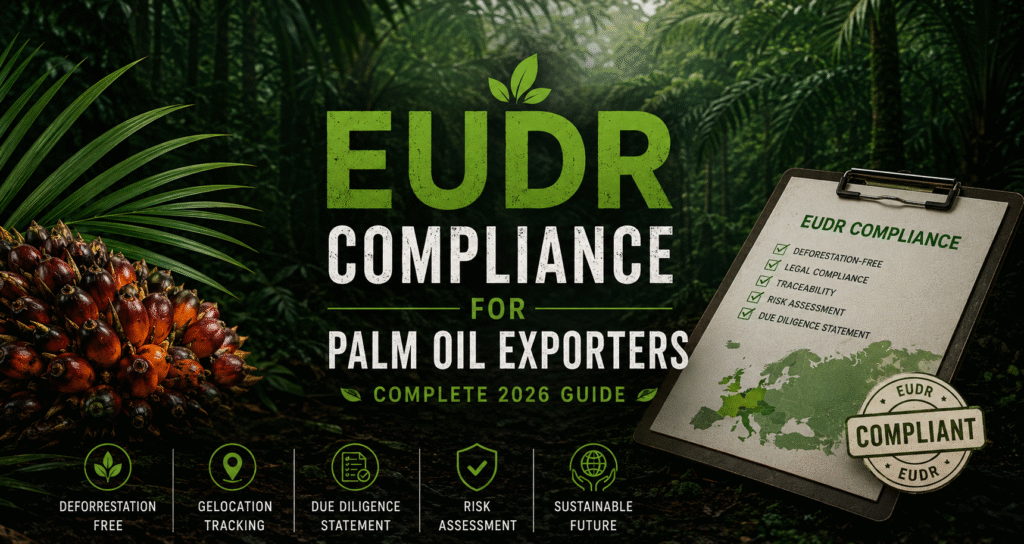
The global palm oil industry is undergoing one of the biggest regulatory transformations in recent years. With increasing concerns over deforestation, biodiversity loss, climate change, and unethical sourcing practices, international buyers and governments are demanding greater transparency across agricultural supply chains. One of the most impactful regulations introduced in this space is the European Union Deforestation Regulation (EUDR).
For palm oil exporters, EUDR compliance is no longer optional. Businesses that wish to continue exporting palm oil and palm-based products to European markets must now demonstrate that their products are deforestation-free, legally sourced, and fully traceable. This regulation is reshaping the way palm oil companies manage sourcing, supplier relationships, documentation, and sustainability reporting.
In this complete guide, we will explain everything palm oil exporters need to know about EUDR compliance in 2026, including requirements, challenges, traceability systems, due diligence obligations, risk assessment methods, and strategies for successful implementation.
What is EUDR?
The European Union Deforestation Regulation (EUDR) is a regulation introduced by the European Union to reduce global deforestation associated with products imported into the EU market. The regulation aims to ensure that commodities sold or exported to the European Union are not linked to deforestation or forest degradation.
The regulation applies to several high-risk commodities, including:
- Palm Oil
- Soy
- Coffee
- Cocoa
- Rubber
- Wood
- Cattle
Palm oil has become one of the most scrutinized commodities because of its historical association with deforestation and land-use change in tropical regions.
Under EUDR, companies must prove that their palm oil products:
- Are deforestation-free
- Were produced on land not subject to deforestation after December 31, 2020
- Comply with local laws in the country of production
- Are fully traceable to the plot of land where they were produced
This regulation affects exporters, producers, processors, traders, importers, and supply chain operators involved in the palm oil industry.
Why EUDR is Important for Palm Oil Exporters
The European Union is one of the major importers of palm oil and palm-derived products. Failure to comply with EUDR requirements can result in severe consequences for exporters, including:
- Shipment rejections
- Financial penalties
- Loss of European buyers
- Increased customs scrutiny
- Market access restrictions
- Reputational damage
For palm oil exporters, EUDR compliance is now directly linked to business continuity and international competitiveness.
Companies that adopt sustainability and traceability systems early will gain advantages such as:
- Better buyer confidence
- Improved supply chain transparency
- Easier access to international markets
- Stronger ESG positioning
- Reduced operational risks
- Increased investor trust
Exporters that ignore compliance requirements may struggle to maintain long-term relationships with European clients.
Key Requirements of EUDR for Palm Oil Exporters
1. Deforestation-Free Production
Palm oil products exported to the EU must not originate from land that has undergone deforestation after December 31, 2020.
Exporters must demonstrate that plantations supplying palm oil were not developed through illegal forest clearing or forest degradation.
Satellite imagery, land records, GIS mapping, and historical land-use analysis are commonly used to verify compliance.
2. Geolocation Data Collection
One of the most important requirements under EUDR is geolocation traceability.
Exporters must collect precise geographical coordinates for all production plots associated with palm oil supply chains.
This includes:
- Plantation coordinates
- Farm boundaries
- Land ownership records
- Polygon mapping for larger farms
The EU requires accurate geolocation data to verify that production areas are not linked to deforestation.
Without geolocation information, exporters may fail compliance checks.
3. Due Diligence Statement (DDS)
Before placing products on the EU market, operators must submit a Due Diligence Statement confirming compliance.
The DDS includes:
- Product details
- Quantity information
- Supplier information
- Country of origin
- Geolocation coordinates
- Risk assessment outcomes
- Verification records
The DDS becomes an official declaration that the exported palm oil complies with EUDR requirements.
4. Risk Assessment
Exporters must conduct risk assessments to identify potential deforestation or legality risks in their supply chains.
Factors considered during risk analysis include:
- Country risk levels
- Deforestation prevalence
- Corruption risks
- Illegal land occupation
- Human rights concerns
- Supply chain complexity
High-risk supply chains require stronger mitigation measures.
5. Risk Mitigation Measures
If risks are identified, exporters must implement mitigation strategies before products are exported.
Common mitigation actions include:
- Supplier audits
- Satellite monitoring
- Third-party verification
- Additional documentation reviews
- Chain-of-custody validation
- Corrective action programs
Companies must maintain records proving that adequate mitigation measures were taken.
Impact of EUDR on the Palm Oil Industry
EUDR is transforming the palm oil industry from a traditional commodity-based model into a data-driven and transparency-focused ecosystem.
Increased Focus on Traceability
Traceability has become a mandatory component of international trade. Palm oil companies are now investing heavily in:
- Digital traceability systems
- GIS mapping technologies
- Blockchain solutions
- Supplier management platforms
- Remote sensing systems
Companies without traceability infrastructure may face operational difficulties.
Pressure on Smallholders
Smallholder farmers contribute significantly to global palm oil production. However, many smallholders lack:
- Proper land documentation
- GPS mapping systems
- Digital recordkeeping
- Compliance awareness
Exporters must now work closely with smallholders to ensure supply chain compliance.
This creates both challenges and opportunities for industry collaboration.
Rising Demand for Sustainable Palm Oil
Global buyers increasingly prefer sustainably sourced palm oil products.
EUDR is accelerating demand for:
- Certified sustainable palm oil
- Ethical sourcing practices
- Responsible land management
- Transparent supply chains
Businesses that adopt sustainability early are likely to benefit from stronger international demand.
How Palm Oil Exporters Can Achieve EUDR Compliance
Build a Traceability System
Traceability is the foundation of EUDR compliance.
Exporters should implement systems capable of tracking palm oil from plantation to final export shipment.
An effective traceability system should include:
- Supplier registration
- Farm mapping
- Batch tracking
- Digital records
- GPS data storage
- Transaction documentation
Modern traceability software can simplify compliance management significantly.
Conduct Supply Chain Mapping
Exporters must identify every participant involved in their supply chain.
This includes:
- Farmers
- Cooperatives
- Traders
- Processors
- Mills
- Transporters
Supply chain mapping helps businesses identify risk points and improve transparency.
Verify Supplier Compliance
Exporters should establish supplier compliance programs.
Key supplier verification steps include:
- Legal land ownership checks
- Deforestation screening
- Sustainability audits
- Documentation reviews
- Environmental assessments
Suppliers failing to meet requirements may need corrective action plans or replacement.
Use Satellite Monitoring Technology
Satellite monitoring has become an essential tool for EUDR compliance.
Remote sensing technology helps companies:
- Detect deforestation
- Monitor land-use changes
- Validate plantation boundaries
- Track environmental risks
Satellite-based monitoring improves transparency and supports risk assessments.
Implement ESG Policies
Environmental, Social, and Governance (ESG) integration supports EUDR readiness.
Palm oil exporters should create ESG policies covering:
- Forest conservation
- Human rights
- Ethical sourcing
- Worker welfare
- Community engagement
- Environmental protection
Strong ESG practices improve buyer confidence and strengthen sustainability credentials.
Challenges Faced by Palm Oil Exporters Under EUDR
Complex Supply Chains
Palm oil supply chains are often highly fragmented and involve multiple intermediaries.
This complexity creates challenges in:
- Data collection
- Traceability verification
- Supplier monitoring
- Documentation management
Digital transformation becomes essential for effective compliance.
High Compliance Costs
Implementing EUDR systems may require significant investments in:
- Technology
- Audits
- Mapping services
- Staff training
- Sustainability programs
However, long-term benefits often outweigh initial costs.
Smallholder Integration Difficulties
Many smallholder farmers lack technical knowledge or financial resources for compliance implementation.
Exporters may need to provide:
- Training programs
- GPS mapping support
- Documentation assistance
- Sustainability education
Collaborative approaches are critical for success.
Data Accuracy Requirements
EUDR requires highly accurate data collection and reporting.
Errors in geolocation coordinates, documentation, or supplier information can create compliance risks.
Companies must establish strong verification and quality control systems.
Benefits of EUDR Compliance for Palm Oil Exporters
Although EUDR introduces new operational responsibilities, compliance also creates long-term business advantages.
Access to European Markets
Compliant exporters can continue serving EU buyers without disruption.
This ensures stable revenue opportunities and long-term market access.
Enhanced Brand Reputation
Sustainability-focused businesses gain stronger credibility among:
- Buyers
- Investors
- Consumers
- Regulatory agencies
Responsible sourcing improves global brand image.
Better Supply Chain Visibility
Traceability systems improve operational efficiency by providing greater visibility into sourcing and supplier performance.
This helps companies identify risks early and improve decision-making.
Increased Investor Confidence
Investors increasingly evaluate ESG and sustainability performance when making funding decisions.
EUDR compliance demonstrates responsible business management.
Competitive Advantage
Companies with strong sustainability systems often gain preference from international buyers seeking low-risk suppliers.
Early adopters may outperform competitors in global trade markets.
Role of Technology in EUDR Compliance
Technology plays a central role in helping palm oil exporters meet compliance obligations efficiently.
GIS Mapping Systems
Geographic Information Systems (GIS) help exporters map plantations and collect geolocation data accurately.
GIS technology supports:
- Boundary mapping
- Risk analysis
- Land-use monitoring
- Environmental assessments
Blockchain Traceability
Blockchain systems create transparent and tamper-resistant supply chain records.
This improves trust and simplifies compliance verification.
Artificial Intelligence and Remote Sensing
AI-powered tools can analyze satellite imagery to detect deforestation patterns and environmental risks automatically.
Automation reduces manual workload and improves accuracy.
Cloud-Based Compliance Platforms
Cloud platforms centralize supplier records, documentation, audits, and traceability data in one system.
This improves operational efficiency and simplifies reporting.
EUDR Compliance Checklist for Palm Oil Exporters
Here is a practical checklist exporters can follow:
Step 1: Understand Regulatory Requirements
Study EUDR obligations and identify affected products.
Step 2: Map Your Supply Chain
Identify all suppliers, mills, plantations, and intermediaries.
Step 3: Collect Geolocation Data
Gather accurate GPS coordinates and polygon maps.
Step 4: Conduct Risk Assessments
Analyze deforestation and legality risks.
Step 5: Implement Risk Mitigation
Apply corrective actions and supplier controls.
Step 6: Establish Traceability Systems
Digitize supply chain tracking and documentation.
Step 7: Prepare Due Diligence Statements
Maintain complete compliance records for EU authorities.
Step 8: Train Suppliers and Staff
Educate stakeholders about EUDR requirements.
Step 9: Monitor Continuously
Use satellite tools and audits for ongoing monitoring.
Step 10: Work with Compliance Experts
Partner with sustainability consultants for implementation support.
Importance of Third-Party Audits
Independent audits can strengthen compliance credibility.
Third-party auditors help verify:
- Supply chain transparency
- Deforestation-free sourcing
- Legal compliance
- ESG implementation
- Traceability systems
Audits improve trust with European buyers and regulators.
Future of the Palm Oil Industry Under EUDR
The palm oil industry is entering a new era focused on sustainability, transparency, and responsible sourcing.
In the coming years, we can expect:
- Greater digitalization
- Increased satellite monitoring
- Stronger ESG reporting requirements
- Expansion of traceability regulations
- Higher buyer expectations
- More sustainable sourcing partnerships
Businesses that adapt early will be better positioned for long-term growth and international competitiveness.
How Detroit Consultancy Can Help Palm Oil Exporters
Detroit Consultancy provides professional support for palm oil companies seeking EUDR compliance and sustainability transformation.
Services may include:
- EUDR readiness assessments
- Traceability implementation
- GIS mapping support
- ESG consulting
- Sustainability audits
- Due diligence documentation
- Supplier risk assessments
- Compliance training programs
By partnering with experienced consultants, exporters can reduce compliance risks and improve global market readiness.
EUDR compliance is reshaping the global palm oil industry. Exporters can no longer rely on traditional sourcing methods without transparency and traceability. European buyers now expect verifiable proof that palm oil products are deforestation-free, legally sourced, and responsibly produced.
Although implementing EUDR systems requires effort, technology investments, supplier collaboration, and operational changes, compliance also creates valuable opportunities. Companies that embrace sustainability and transparency will gain stronger buyer trust, better market access, and long-term competitive advantages.
The future of palm oil exports depends on responsible sourcing, digital traceability, ESG integration, and proactive compliance management. Businesses that act early will not only meet regulatory expectations but also position themselves as leaders in the evolving global sustainability economy.