
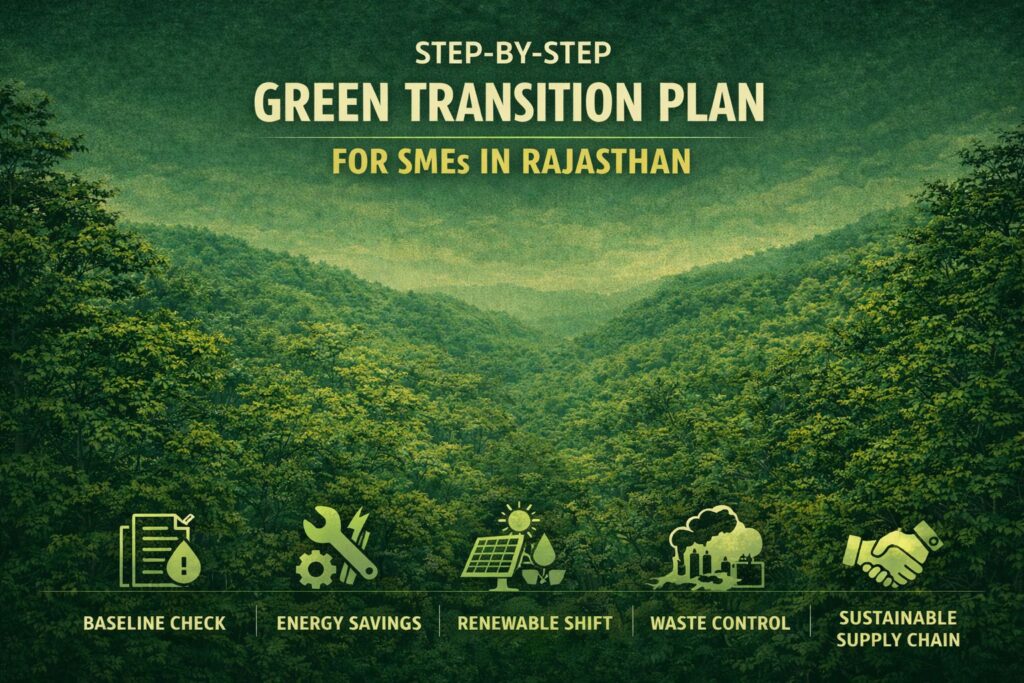
Why SMEs in Rajasthan Must Act Now
For small and medium enterprises (SMEs) across Jaipur and Bhiwadi, sustainability is no longer an optional initiative—it is rapidly becoming a core business requirement.
Manufacturing units are facing increasing pressure from multiple directions:
- Rising demand from international buyers (EU, UK) for sustainable sourcing and compliance
- Escalating energy and fuel costs affecting operational margins
- Stricter environmental regulations and pollution control norms
- The growing importance of ESG (Environmental, Social, and Governance) standards in business evaluation
The encouraging reality is that transitioning towards sustainability does not require heavy upfront investment. What businesses truly need is a structured, phased, and ROI-driven transition plan.
The Practical 7-Step Green Transition Plan
Step 1: Conduct a Quick Baseline Assessment (7–10 Days)
The first step is to establish clarity through data. Avoid complexity and focus on essential metrics:
- Electricity consumption (last 12 months)
- Fuel usage (diesel, gas, coal)
- Water consumption
- Waste generation
Outcome: A clear and basic sustainability snapshot of your operations, forming the foundation for future decisions.
Step 2: Identify Immediate Improvement Opportunities
Before making investments, focus on “low-hanging opportunities” that deliver quick results with minimal effort:
- Fix leakages (air, steam, water systems)
- Reduce idle machine energy consumption
- Upgrade inefficient lighting systems
Most SMEs can achieve 5–10% cost savings immediately by addressing these inefficiencies.
Step 3: Optimize Energy Usage (High ROI Zone)
Energy optimization is one of the most impactful areas for cost reduction:
- Replace outdated motors with energy-efficient alternatives
- Optimize compressors and boiler systems
- Install Variable Frequency Drives (VFDs)
Expected ROI: Typically within 6 to 18 months, making this a financially viable step.
Step 4: Transition to Renewable Energy (Phase-wise Approach)
Adopting renewable energy should be gradual and strategic:
- Begin with rooftop solar installations for partial load
- Transition towards a hybrid energy model over time
Rajasthan’s high solar exposure makes this step particularly beneficial, offering both cost savings and sustainability advantages.
Step 5: Strengthen Water and Waste Management
Efficient resource management reduces both operational costs and compliance risks:
- Reuse and recycle process water
- Implement waste segregation practices
- Monetize or reuse scrap materials
This step not only enhances efficiency but also supports regulatory compliance.
Step 6: Measure Your Carbon Footprint
Understanding emissions is essential for future readiness:
- Start by calculating Scope 1 and Scope 2 emissions
- Gradually expand to Scope 3 emissions
This prepares your business for:
- Export market requirements
- ESG reporting frameworks
- Future regulations such as Carbon Border Adjustment Mechanism (CBAM)
Step 7: Build a Sustainable Supply Chain
Sustainability is no longer limited to internal operations—it extends across the supply chain:
- Evaluate suppliers based on environmental impact
- Prioritize sustainable and low-impact raw materials
- Reduce packaging and optimize logistics
Increasingly, global buyers consider supply chain sustainability a mandatory criterion.
What SMEs Can Realistically Achieve
By implementing a structured green transition plan, SMEs can expect:
✔ 10–25% reduction in energy costs
✔ Improved acceptance in export markets
✔ Enhanced regulatory and ESG compliance readiness
✔ Stronger brand positioning and market credibility
Common Mistakes to Avoid
While transitioning, businesses should avoid the following pitfalls:
- Attempting to implement everything at once
- Investing without clear ROI evaluation
- Neglecting proper data tracking and measurement
- Treating sustainability purely as a marketing activity
A successful transition requires a phased, practical, and measurable approach.
Final Thoughts
For SMEs in Rajasthan, the goal is not an overnight transformation but a strategic and sustainable transition.
Small, consistent improvements—backed by data and clear ROI—create long-term business value and resilience.
How Detroit Consultancy Can Help
If your business operates in Jaipur, Bhiwadi, or the NCR region and you are looking to:
- Reduce operational costs
- Begin your carbon footprint journey
- Prepare for export regulations and ESG compliance
Detroit Consultancy can design a customized Green Transition Plan tailored to your operations.
👉 Let’s build a practical, scalable, and ROI-driven roadmap for your business growth and sustainability.