
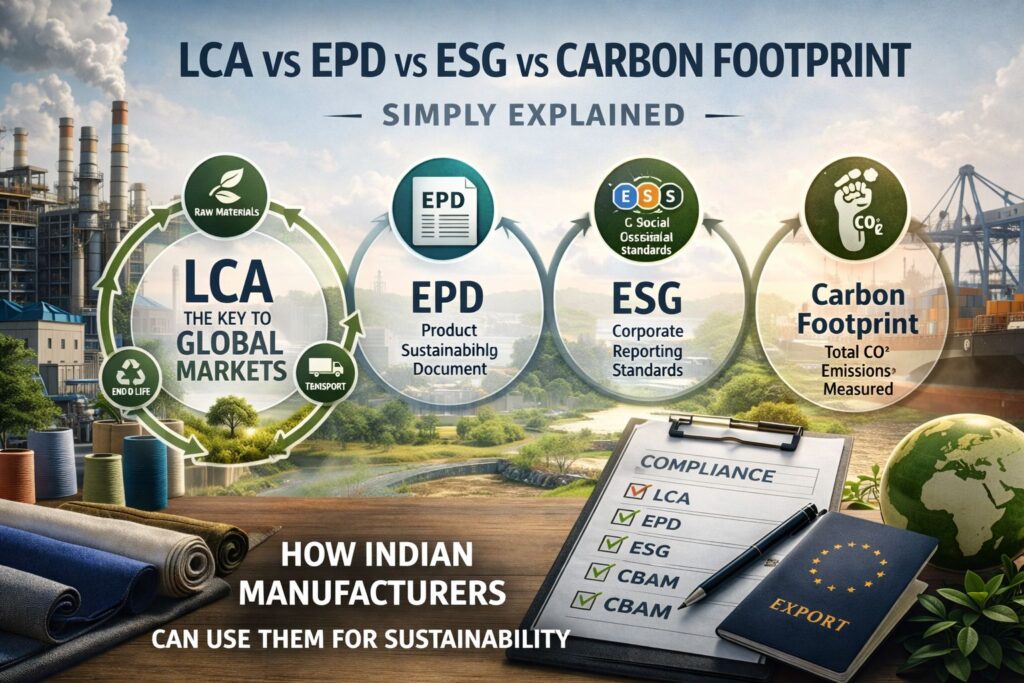
The Confusion Every Manufacturer Faces
If you have recently interacted with buyers, consultants, or auditors, you’ve likely encountered questions such as:
- “Do you have LCA?”
- “We need EPD data.”
- “What is your ESG reporting status?”
- “Can you share your carbon footprint?”
The natural response is:
👉 “Are these all the same thing?”
The answer is no—but they are closely interconnected.
Let’s Simplify It (Without Technical Complexity)
Think of these concepts in a structured way:
| Term | What It Really Means |
|---|---|
| LCA | The calculation engine |
| Carbon Footprint | A specific output from LCA |
| EPD | A formal report based on LCA |
| ESG | The broader business strategy |
👉 Once you understand this relationship, the confusion disappears.
1. What is LCA (Life Cycle Assessment)?
Life Cycle Assessment (LCA) is a methodology used to evaluate the environmental impact of a product throughout its entire lifecycle.
It includes:
- Raw material sourcing
- Manufacturing processes
- Transportation
- Product usage
- End-of-life disposal
👉 LCA is the foundation of all sustainability reporting.
2. What is Carbon Footprint?
Carbon footprint refers to the total greenhouse gas (CO₂) emissions associated with a product, process, or organization.
Key points:
- It is one component of LCA, not the complete assessment
- Focuses only on emissions, not broader environmental impacts
👉 Example:
A textile manufacturer may calculate emissions as kg CO₂ per meter of fabric.
3. What is EPD (Environmental Product Declaration)?
An Environmental Product Declaration (EPD) is a standardized, third-party verified document that presents LCA results.
👉 Think of it as:
“Your product’s sustainability report card.”
It includes:
- Verified environmental impact data
- Standardized reporting format
- Acceptance by international buyers, especially in Europe
👉 No LCA → No EPD
4. What is ESG?
ESG (Environmental, Social, and Governance) is a comprehensive framework that evaluates the overall sustainability and ethical impact of a business.
It covers:
- Environmental: Emissions, energy use, LCA
- Social: Labor practices, employee safety
- Governance: Ethics, compliance, transparency
👉 LCA is a part of ESG—not the entire framework.
A Simple Way to Visualize It
Think of a pyramid structure:
- Base: LCA
- Next Layer: Carbon Footprint
- Above: EPD
- Top: ESG
👉 Everything begins with LCA.
Industry Case Example
Plywood & Laminates (North India & Gujarat)
Without Clear Understanding
A manufacturer attempts to directly prepare ESG reports without foundational data:
- No proper LCA
- Unable to generate EPD
- Incomplete sustainability metrics
👉 Result:
- Buyer rejection
- Compliance gaps
- Lost opportunities
With the Right Approach
A structured implementation process is followed:
- Conduct LCA
- Extract carbon footprint data
- Develop EPD documentation
- Integrate findings into ESG reporting
👉 Result:
- Clear and compliant documentation
- Improved buyer confidence
- Stronger export positioning
Why This Matters for Indian Manufacturers
Industries most affected include:
- Ceramics (Morbi, Gujarat)
- Plywood & laminates (North India)
- Textiles (Ahmedabad, Surat)
- Bathware & electrical fittings
- Agro processing (castor oil, soybean)
- Automobile components
👉 If you are export-oriented, these requirements are either already in place or coming very soon.
Common Mistakes to Avoid
Many companies make critical errors such as:
- ❌ Jumping directly into ESG reporting
- ❌ Ignoring the LCA foundation
- ❌ Treating carbon footprint as the only metric
👉 This often leads to:
- Incomplete compliance
- Rework and delays
- Missed business opportunities
The Smart Approach
A structured, step-by-step strategy works best:
✔ Start with LCA
✔ Build accurate and reliable data
✔ Expand into EPD documentation
✔ Integrate into ESG strategy
👉 Do it progressively—not all at once.
How Detroit Consultancy Supports You
We assist Indian manufacturers in:
- Understanding the exact requirement (LCA vs EPD vs ESG)
- Developing LCA models aligned with international standards
- Preparing EPD documentation
- Integrating sustainability into business strategy
👉 Our objective is simple:
Eliminate confusion and enable business growth through clarity and compliance.
The Bottom Line
LCA is the starting point—and everything else depends on it.
When LCA is implemented correctly:
- Compliance becomes simpler
- Reporting becomes structured
- Export processes become smoother
Take the Next Step
If you are unsure where to begin:
👉 Don’t rely on guesswork—gain clarity.
Detroit Consultancy can guide you step-by-step—from LCA to ESG implementation.